The purpose of this article is to give us a greater understanding of tassels, and look into the seemingly vague and somewhat contradictory words that translators use when translating the two scriptures regarding tassels.
We will look at how most people wear them, what its true name is, what it is to be made of, how long they should be, how many fibers should be used, how they are made, how to attach them, and where on our clothing they are to be worn. It is my hope that you will conclude, as I did, that the evidence is obvious and very specific—the tzitzit is a lock of threads, twisted into a gedil and sewn with blue thread to the four edges of a garment.
The scripture references
There are only two scriptures that mention wearing tassels, they are in Numbers and Deuteronomy.
Speak to the people of Israel, and tell them to make tassels on the corners of their garments throughout their generations, and to put a cord of blue on the tassel of each corner . . . It shall be a tassel for you to look at and remember all the commandments of the LORD.(Num 15:28,39 ESV).
Sew tassels for yourselves on the four corners of the garment with which you cover yourself (Deut 22:12 ISV).
How most people wear them
- Wear 4 tassels on a prayer shawl
- Wear 4 of them on their shirt
- Wear them on their belt loops
- Wear fringes on the edge of the shirt
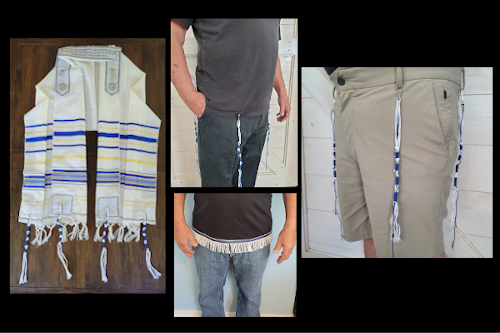
As we can see from the pictures, there are many different ways people wear the tassels and fringes. The confusion lies in part with the different translations of the Bible, and how some of those words have been translated incorrectly. We will find the truth in the Hebrew meaning of the words, how those words should be translated, and compare scriptures using the Bible to interpret the Bible.
It’s all in the name
Translators alternately use tassels and fringes no matter whether the Hebrew word is tzitzit or gedil. Tzitzit (tsee-tseeth’) means lock, and gedil (ghed-eel) means twisted threads. How can two different Hebrew words, tzitzit and gedil, with different Hebrew definitions, be translated alternately tassel or fringe? They can’t be; not in this case. We shall see exactly what these two different Hebrew words are referring to.
Look at Numbers 15:38. “Speak to the people of Israel, and tell them to make tassels [tzitzit] on the corners of their garments throughout their generations.” The word tzitzit is Strong’s 6734. It is the English word lock; the reference scripture we use to understand this, Ezekiel 8:3, leaves no doubt. “With his hand he grabbed a lock [tzitzit] of my hair.”
Moses is not telling them to make a tassel or fringe, because the word is lock. Moses is telling them, I want you to accomplish a task and it will become become something else. The following two scriptures describe how something becomes something else. “And thou shalt make a plate of pure gold, and grave upon it, like the engravings of a signet, HOLINESS TO THE LORD” (Exodus 28:36 KJV). Then in Exodus 29 there is the final product with its proper name. And you shall set the turban on his head and put the holy crown on the turban (29:6 ESV). The gold plate becomes a holy crown (tzitzit) becomes twisted threads (gedil) .
In Numbers 15:38 the lock is not called a gedil. It does not have that name yet, because it has not been created. As in Exodus 28:36 the plate also does not have a name yet, because it has not been made yet.
Using a wood-working analogy, the words make wood‘ mean different things to different people; however, a skilled craftsmen in woodworking would know to cut down a tree and start milling it; he would make slabs of wood and posts. Similarly, here is what Moses is telling the children of Israel: I want you to make wood, and put a nail of blue on each of the four posts at the four corners of the rectangular slab of wood. The wood now becomes a table.
Translators also use the same two words, tassel and fringe, to translate the word gedil in Deuteronomy 22:12, but it is a completely different word in Hebrew. It is Strong’s 1434, gedil, which means twisted threads. Let’s look at Deuteronomy 22:12, using the JPS version (Jewish Publication Society). They translate it correctly. “Thou shalt make thee twisted cords, upon the four corners of thy covering, wherewith thou coverest thyself.” Moses called it a lock in Numbers and twisted threads in Deuteronomy. Gedil—twisted threads—is what the tzitzit (lock) has become. In the same way, we would not call flour bread, nor would we call wood a table. Flour has become bread, wood has become a table, gold plate has become a holy crown, and a tzitzit has become a gedil. Gedil is the name of the final product.
Making the lock
In Numbers 15:38 Moses is telling them to make a lock. What is a lock? This is Merriam Webster’s definition for lock. “A cohering bunch (as of wool, cotton, or flax).” These are the materials that the children of Israel would have used to make a lock. In this day and age we refer to a lock as a few strands of hair. The Bible refers to it as hair also, but it also refers to it as a number of threads grouped together. In this case, it refers to the lock as threads.

How do we make a lock? The picture on the right is shows the sates of making a lock from the stalks of the flax plant. The stalks are on the left and the fibers that have been stripped out of the stalks are in the middle. These fibers are called tow, as stated in Judges 16:9, “as a thread of tow is broken when it toucheth the fire.” (If you did not know, this is where the term towhead comes from.) On the far right are the tow, which have been spun into threads.
Cohere those threads together and you now have a tzitzit (lock) with which to make the gedil. Making the tzitzit is quite a process. The children of Israel had to process the raw materials to make everything they needed or wanted. So they knew exactly what Moses meant when he said, “make a lock.”
Moses is not telling them to make a tassel or fringe, because the word is lock and there is no Hebrew word that I have found for tassel or fringe in the Bible. The tzitzit (lock) is a part of what they are going to make, and it will become a gedil (twisted thread).
What is the gedil to made of?
The gedil is to be made of the same material as the clothing that you’re going to attach it to. As the instruction states in Leviticus 19:19, “or wear a garment upon you of two kinds of material mixed together” (NAS). The type of fiber used to make the gedil had to match the fiber of the clothing they were going to sew it on. So if they had a linen shirt they would make the gedil from linen. If they were going to put the gedil on a wool coat they would make the gedil from wool. Moses did not give specific instructions for what material to use because the children of Israel already knew the command not to mix wool and linen.
How long should the gedil be?
Moses doesn’t say what length the gedil should be. The reason could be that the length of the gedil is determined by the clothing size, e.g. a larger person would require a longer length than a shorter person. Or it could be that the length of the gedil is left up to the individual who is wearing it. After all, the reason for wearing the gedil is to remind them of His commandments, and since not everyone is reminded of things in the same way, some latitude may have been given for the length and thickness of the gedil.
How many fibers are in the lock to make the gedil
The gedil is a reminder to keep the commandments. So it could be that it’s left up to the individual who is wearing them, whether they be thick with many fibers or thin with a few. In other words it would have been whatever it took that would cause them to remember. If there were a specific length or quantity restriction Moses would not have used the word lock by itself. As explained earlier, a lock is a cohering of fibers of an indeterminate length and an indeterminate quantity. If thickness had been important then Moses would have given them exact numbers.
However, in Matthew 23:5, Yashuah pointed out that the Pharisees had abnormally large gedils on the borders of their garments. “But all their works they do to be seen of men, they make broad their phylacteries and enlarge the borders of their garments.” Their borders were large because their motive was to be seen by men.
The very observant Torah-keeping Pharisees must have felt that there was no legal restriction to the size of the gedil. So I do not see where size or length was a legal restriction, especially because it is not specified anywhere in the scriptures.
The thing about reminders is that they are quite individualistic. For instance, my dad would put a handwritten note, slid in between the frame and the plastic of the instrument panel of his car, so that when getting in or out of his car during the course of a day, he would see it and be reminded of what he needed to do and not forget. To remind themselves, some people use handwritten notes; some use the calendar on their computer; some use a real calendar on their refrigerator; some scribble a a small note on their hand. Some folks use sticky notes everywhere.
The bottom line is that the number of fibers and the size of the gedil is not as important as remembering to keep the commandments without boasting.
How the gedil is made
To start out, cohere a number of threads together. I use about 5 to 10 threads to make the lock, and
they should be long enough for the application you need. I like to start out with about 10 feet.
Next take the lock of threads, (I use about 5 to 10 threads), and attach one end on a hook that has been securely fastened in a drill motor. Attach the other end to a hook that is securely fastened in a post or a wall. Then twist the threads with the drill motor until there is enough tension in the twist to fold it in half. When you fold it in half it will remarkably twist onto itself. After you tie a knot in the loose ends it will not unravel. Keep in mind because of the twisting and folding over, it will be less than half the length of what you start with, but it will double in thickness and become stronger.
It is interesting to note that the word gedil (twisted threads) comes from the word gadal which means to grow, become strong. It is Strong’s 1431. Here is the definition from Brown-Driver-Briggs: verb grow up, become great twist, twine, Arabic twist a cord, make firm, strong, become strong. This is how the lock becomes a gedil.
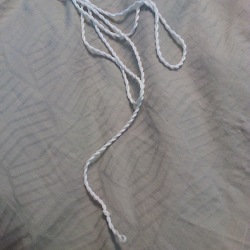
After the twisting is completed, the gedil is ready to cut up into the length you would like and sew onto the four extremities of the garments with the blue thread. The end result looks similar to a cable. This is good because related root words look like a cable.
Look at 1 Kings 7:17, “There were nets of network and twisted threads of chainwork” (NASB 1995). The word twisted threads is the word gedil, and the word chain is the Hebrew word sharsherah (Strong’s 8333). It has been translated to the word chain, but this is wrong. It is not a chain at all based on the root word and the function of it. It should be translated to the word cable. The chain was not invented until 225 bc. (See this link for more information)
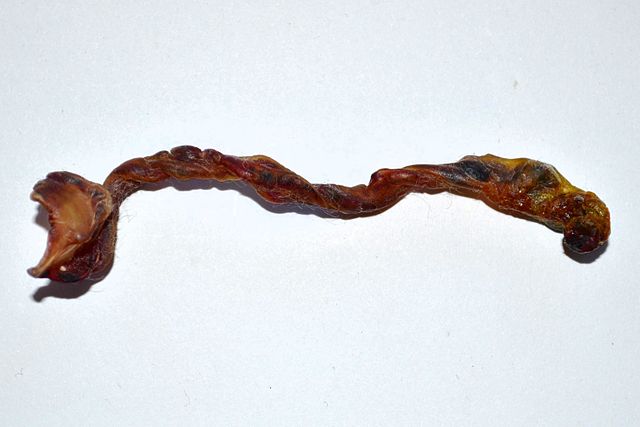
The Hebrew root word for chain is shor (Strong’s 8270). It is translated to umbilical cord. The twisted threads in 1 Kings 7:17 are threads of gold, very fine threads twisted together, as the scripture says, to make a cable, not linked like a chain. The end product looks like a cable. So what does the root word umbilical cord have to do with cable? This is because an umbilical cord looks like a cable
Another argument for the word cable is in Exodus 28:22, “You shall make for the breastpiece twisted chains like cords, of pure gold” (ESV). This is pure gold; you can’t make a chain from pure gold because it’s too soft. Whatever you attach to it would fall down, especially a breastplate. Consider how heavy the breastplate would have been with 12 gold settings holding twelve stones all sewn onto a very thick piece of linen, too heavy for a pure gold chain to be of any use. Yet if you make fine threads of pure gold and twist them together you would have a cable that would be strong enough to hold the weight of the breastplate. It would look like the root word umbilical cord.
How it is to be attached
The gedil is to be sewn onto the garment with the blue thread. Keep in mind that the blue thread would be the same material as the garment and the gedil.
Translators use various words for what to do with the blue thread such as put, attach, tie. But all these words come from the same Hebrew word nathan. It is Strong’s 5414; the definition is give, put, or set . The NLT translates the word nathan correctly in Numbers 15:38. “Give the following instructions to the people of Israel: Throughout the generations to come you must make tassels [lock] for the hem of your clothing and attach [nathan) them with a blue cord.”
The word nathan is used 2011 times in the scriptures, and after reading several of these scriptures, the conclusion we come to is that when something is given, set, or put it is not to be moved from that position, it is permanent; that is where it is meant to be. Here is a scripture that uses the word set translated from the word nathan in Genesis 1:17. “And God set them in the expanse of the heavens to give light on the earth.” The sun, moon, and stars are set where they are supposed to be and are not likely to be moved.
Let’s look at Exodus 28:37 again. “You shall make a plate of pure gold and engrave on it, like the engraving of a signet, ‘Holy to the LORD.’ And you shall fasten [fasten is the word nathan] it on the turban by a cord of blue. It shall be on the front of the turban” (ESV). The NLT is more direct. “Attach the medallion with a blue cord to the front of Aaron’s turban, where it must remain.”
The gedil is to be attached to the garment with the blue thread. Kiel and Deltzgch OT Commentary agrees.
The blue thread is not a cord, ribbon, or string. It is not woven in, braided in, or just dangling randomly. If the blue thread were to be woven, braided, or laced in some way or another the instructions would have clearly stated that because there are Hebrew words for those words. So in this particular case the blue thread is a thread, and its purpose is to sew the gedil to the garment.
What is this blue thread
As we have seen, translators use many different words to describe the same Hebrew words. The same holds true for the word thread. They use words such as ribbon, lace, thread, cord, and string; but how do we know that the blue thread is a thread and not a ribbon, lace, cord or string? We know because Moses uses the Hebrew word pathiyl (Strong’s 6616), and it means cord or thread, definitely not a ribbon or lace. The Hebrew word pathiyl comes from the Hebrew word pathal, and it means to twist (Strong’s 6617). We twist cords, string, and threads, not ribbons or lace.
Ribbons are woven and lace is crocheted. If it were a ribbon, Moses would have used the Hebrew word saphah (Strong’s 8193). The word saphah resembles what a ribbon is, as found in Exodus 28:32, “It shall have an opening for the head in the middle of it, with a woven binding around the opening, like the opening in a garment, so that it may not tear” [emphasis added]. This long, flat strip of material is woven, not twisted. This material fits the description of a ribbon. Moses would have used the word saphah, not pathiyl if he wanted the children of Israel to use a ribbon.
If the blue thread were lace, or to be braided into the gedil, as some translators suggest, then Moses would have used the Hebrew word machalaphah (Strong’s 4253). The meaning is a plait of hair. This is what Brown, Driver, Briggs says: “of hair; so called from intertwining, passing through each other, of the strands.” The word machalaphah comes from the Hebrew word chalaph (Strong’s 2498). The meaning is to pass on or away, pass through. This is how you make lace or a braid. When you lace or braid, the work is passed over and through. Machalaphah is the word to describe lace or braid, and it would have been used instead of the word pathiyl.
The Hebrew word pathiyl means twisted string, cord, or thread, but how do we know when it should be translated as either a string, cord, or thread? It is depends on the context in which the word is being used. In other words, what is the pathiyl being used for?
For example, Judah, in Genesis 38:18, says, “’What pledge shall I give you?’ She replied, ‘Your signet and your cord and your staff that is in your hand.’ So he gave them to her and went in to her, and she conceived by him.” The word cord in this scripture is the word pathiyl, and it is used to tie the signet around the neck. This would most certainly be something thicker than thread because if it were not it might have broken and resulted in the loss of the signet. In the same way you would not want to lose your credit card, they would have made sure their signet was secure. Do you think identity theft is new?
Why did she want both the walking cord and signet? Why not just the signet?
The following are my personal thoughts as to why:
- Maybe she thought a signet could get lost and another person may find it such as herself. If she tried to make a claim with just the signet Judah might say, “Yes that’s my signet, but I lost it about nine months ago and you just happened to find it. That’s no proof the kid is mine. Thank you for returning it. See you later.” But if she had both the cord and signet, it would be more likely that he would have given it to her, thus making her claim more valid.
- She would have 3 pieces of evidence to support her claim: the signet, cord, and walking stick. She probably ate the goat. What does the Bible say about two or three witnesses?
You might think that all the cords were similar, but the Bible specifically says ”his cord.” Back then you had to make your own cord and thus he would have made it his own, perhaps twisting his favorite colors into it. It was not like they could just go to Walmart and pick up a cord and everyone would have had the same type and color. I believe everyone knew whose cord, whose signet, and whose walking stick belonged to whom. Tamar was smart.
In Numbers 19:15, pathiyl is used to tie a covering over an open vessel. “And every open vessel which has no covering of thread on it is unclean.” In this application this would not be a thread. It is too thin. A string or thin cord would be used, a string if the covering were made of linen and a cord if the covering were animal hide. In Exodus 39:3 pathiyl is a thin gold thread woven into the priest’s garment. “And they hammered out gold leaf, and he cut it into threads to work into the blue and purple and the scarlet yarns, and into the fine twined linen, in skilled design.” In this application it would be a thread, anything else would be too thick, they would not be able to weave it into the thread,
In Judges 16:19 pathiyl is used as an example of how easily Samson snapped the ropes that bound his hands together “as a thread.” In Ezekiel 40:3 pathiyl is used as a measuring tape. “With a linen cord and a measuring reed in his hand. And he was standing in the gateway.” This would have been a cord because a thread would not hold up to repeated use of measuring things.
So when attaching the gedil to the garment a blue thread would have been used to sew it on. By the way, the commandment does not say that the gedil is of any particular color, so I would assume that the gedil could be whatever color you wanted–as long as you sew it on with a blue thread.
What type of garment?
Moses says in Deuteronomy 22:12 that the gedil is to be attached upon the four extremities of your garment. There are two things we need to look at. First, what type of garment is Moses talking about and second, where are the four extremities?
The word garment is everyday apparel worn by everyone and not limited to any specific piece of clothing, or class of people. If it were, Moses would have said so, as there are plenty of Hebrew words for specific garments such as a robe. The Hebrew word for robe is meil (Strong’s 4598). Moses would have used this word if he wanted them to put the gedil exclusively on a robe.
Strong’s definition of garment (899) is the Hebrew word behg’-ed. Its meaning is apparel. Here is what the commentary of Brown-Driver-Briggs says about it: “garment, clothing, raiment, robe of any kind, from the filthy clothing of the leper to the holy robes of the high priest, the simplest covering of the poor as well as the costly raiment of the rich and noble, used throughout Hebrew literature.”
It is reasonable to conclude that the children of Israel were supposed to put the gedil on the clothing they would wear everyday, whether a robe or a shirt or other clothing. It is interesting to note that it was never mentioned as part of the priestly garments.
The four extremities
Where are the four extremities of a garment? Most garments have four extremities. There is one extremity at the opening where the head would go through, and two extremities where the arms go through and one extremity at the bottom where the torso would go through. If we think of four corners instead of four extremities as is the true definition of that word, then we would think the gedil would go on an article of clothing which has four corners like a prayer shawl, or a poncho. But the commandment doesn’t say four corners, it says four extremities. If we were supposed to put them on corners of our garments, Moses would have said put them on the corners (pinnah, Strong’s 6438), as stated in Exodus 27:2, “And you shall make horns for it on its four corners.” Or as stated in 1 Kings 7:34, “There were four supports at the four corners of each stand.” But he does not. Therefore, we must use the word extremities and find the meaning in it.
Is it coincidental that we are to love our heavenly Father with our mind, with our strength, and with our whole being? Maybe the four extremities represent this, one opening for the head relating to the mind, two openings at the arms relating to our strength and one opening at the torso relating to our whole being.
How can something so simple be so confusing? It is because the translators use many different words to describe the one Hebrew word. In this case, the word extremities has been translated as a bird, corners, covering, edge, ends, fold, garment, skirt, borders, hem, bottom, and wing. There are Hebrew words for each one of these words, and if the gedil were to be placed at the location as described by one of these words, Moses could have used that particular Hebrew word and not the word extremities.
The word extremities is the Hebrew word kanaph (Strong’s 3671). It simply means wings or extremities. A bird has four extremities, but only two of those extremities are wings, with its head and tail feathers making a total of four. Garments on the other hand have four extremities but none are wings. Therefore all wings are extremities but not all extremities are wings. So, in our day-and-age if we are talking about garments worn by humans then we should use the word extremities. Likewise, if we are talking about birds we should use the word wings.
Part of the confusion comes from our common usage of these words and not knowing how some of the words relate to each other. As in the term taking someone under their wing and passing the mantle on, these two words are common to birds and humans. A bird will mantel its young and its prey by spreading its four extremities over them, its head, two wings, and tail feathers. In doing so, it protects its young and its prey from other predators.
Those words are common to both birds and garments and no doubt creates some confusion. Another example is the word corner, as in hide in a corner. When a bird folds its wings are they not hidden? Wing is the root word for Strong’s 3670 which means to be cornered or thrust into a corner, be removed. If something is removed, how can we see it? If something is in a corner it may not be easily seen as compared to something that is out in the open. If the gedil is to be slightly hidden, being sewn under the garment at the four locations, as I believe it should be, then we can see how the word corner might be used by the translators.
The other reason I believe this is because the scripture says, “When you look at it” referring to the gedil (Num 15:39) it will remind us of our heavenly Father’s commandments. The word look is the Hebrew word raah (Strong’s, 7200). And in the Apostolic Bible Polyglot they use the Greek word horaó Strongs # 3708
Strong’s Exhaustive Concordance behold, perceive, see. Properly, to stare at (compare optanomai),
i.e. (by implication) to discern clearly (physically or mentally); by extension, to attend to; by
Hebraism, to experience; passively, to appear — behold, perceive, see, take heed.
Interestingly enough, here is Rashi’s commentary of the word look. “[It is called] צִיצִת because of the [command], ‘you shall see it’ (verse 39), as in, ‘peering (מֵצִיץ) from the lattices‘” (Song 2:9). When looking through a lattice, nothing on the other side is as visible as it would be if the lattice were removed. In other words, you shall see the gedil as if peering through a lattice, which means it would take some effort to see it. The gedil is not easily seen.
Deuteronomy 22:30 says, “A man shall not take his father’s wife so that he shall not uncover his father’s skirt” (NAS). The Hebrew word translated to skirt is the word extremities. If you can uncover it, it must be covered and therefore not easily seen. You can’t see a bird’s wings until it takes flight. To make something seen, one would think it is not in plain view.
Consider what Yahshua said in Mat 23:5. “But all their works they do for to be seen by men: they make broad their phylacteries, and enlarge the borders of their garments.” If the Pharisees are trying to make it seen, one would think it must not be easily seen. The gedil is something that should be out of view, and not drawing attention; not in plain sight. After all, it is a reminder the person wearing it, not a witnessing tool.
So, is the conclusion that the gedil should never be seen? Not really. However, it does not have to be seen in order to be in compliance with the instructions.
What we know for sure
The gedil is twisted threads made from a lock of threads and it attaches upon your clothes at the four extremities with the blue thread. There is nothing that says it cannot dangle down, however, Moses did not say that it needed to dangle down. I believe it is not seen because there is more pointing to it not being easily seen.
The instructions do not say that the gedil goes completely around your clothes. The reason we know this is because Moses would have used the Hebrew word sabib, as he did in Exodus 28:32, “It shall have an opening for the head in the middle of it, with a woven binding around the opening.” And in Exodus 28:33, “On its hem you shall make pomegranates of blue and purple and scarlet yarns, around its hem, with bells of gold between them.”
The word around is sabib. It means roundabout or circuit (Strong’s 5439). If the instructions were to put the twisted threads around the garment Moses would have said to put it around the garment. But he did not. You can not break a circuit. If you do it is no longer a circuit, which would mean that you could never put it on anything but a pullover, certainly not a shirt or jacket that would have an opening down the front of it, and if that were the case the word garments, as the commandment states, would be invalid because garments mean any and all apparel.
Can it be sewn completely around the bottom of a shirt or coat? Yes, but Moses doesn’t say that it should.
Am I saying that we should wear the gedil and we are damned if we do not? Not at all. This is between you and Yahweh. The purpose of this article is to present factual evidence and information from scripture in order for us to see the scripture plainly, so that anyone will know how to make them, where to put them, and how to attach them.